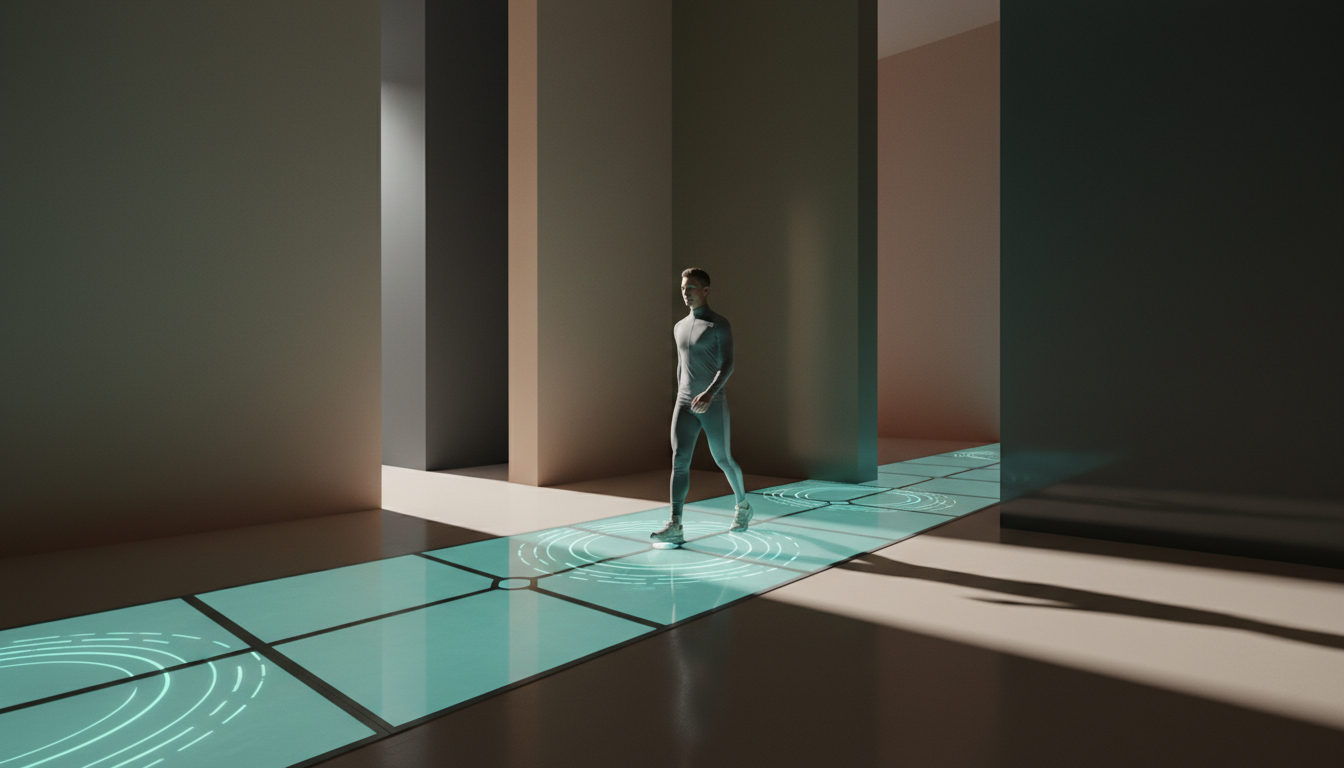
Your Gait Is a Stress Test for Aging, Measure It Like One
Walking speed and stability are not “fitness vibes”, they are readouts of muscle, balance, and brain health under load. The 2024-2025 shift is toward treating gait as a trackable biomarker, then training the specific failure mode it reveals.
Why it matters:
Gait declines early, often before obvious disability, because it integrates strength, power, sensory input, cognition, and cardiovascular reserve. When gait quality drops, fall risk rises, and so does the probability that sarcopenia and chronic disease are already eroding capacity. Sarcopenia is tightly linked to worse outcomes, including falls and mortality, and it is amplified by comorbid disease (Damluji et al., Circulation, 2023).
The evidence:
- Sarcopenia is not isolated muscle loss, it is a systemic risk state. A 2023 review in Circulation (Damluji et al.) connects sarcopenia to cardiovascular disease progression and higher risk of falls and death, which helps explain why gait changes can signal deeper physiologic decline.
- Exercise is the highest-leverage intervention for the muscle side of gait. A 2023 network meta-analysis in Journal of Cachexia, Sarcopenia and Muscle (Shen et al.) compared exercise modes for sarcopenia, supporting the practical takeaway that structured training meaningfully improves patient-important outcomes, not just aesthetics.
- Footwork precision training can reduce fall risk signals. A 2024 study in IJISRT (Surya C.K, Chandran, Praveena) found Square Stepping Exercise (SSE) improved measures related to fall risk in older adults, suggesting gait is trainable with targeted coordination, not only strength work.
What to do: A practical gait-assessment protocol (10 minutes, weekly)
Run this as a simple home screen. Track results in notes.
- 1) Usual-pace 10-meter walk
- Mark 10 meters, time your normal walk.
- Record seconds and compute speed (m/s = 10 divided by seconds).
- 2) Fast-pace 10-meter walk
- Repeat “as if crossing a street safely.”
- The gap between fast and usual pace is your reserve.
- 3) Dual-task walk
- Repeat usual pace while naming animals (or subtracting by 7s).
- Record: did speed drop, did you pause, did you lose your place.
- 4) Turn test
- Walk 3 meters, turn 180 degrees, return.
- Record: number of steps to turn, and whether you felt unstable.
- 5) Single-leg stance
- Time each leg, stop if you wobble or put the foot down.
- This is a fast proxy for balance capacity that often predicts gait issues.
Then train the bottleneck:
- If speed and reserve are low, prioritize progressive resistance training and power-focused sit-to-stands (supported by the broader sarcopenia exercise evidence, Shen et al., 2023).
- If dual-task and turning degrade, add SSE-style stepping patterns and direction changes (Surya et al., 2024).
- If balance is the limiter, add daily single-leg balance progressions near a stable support.
The counterpoint:
Gait can worsen from pain, neuropathy, medications, or acute illness, so a sudden drop should be treated as a signal to assess causes, not as a motivation problem.