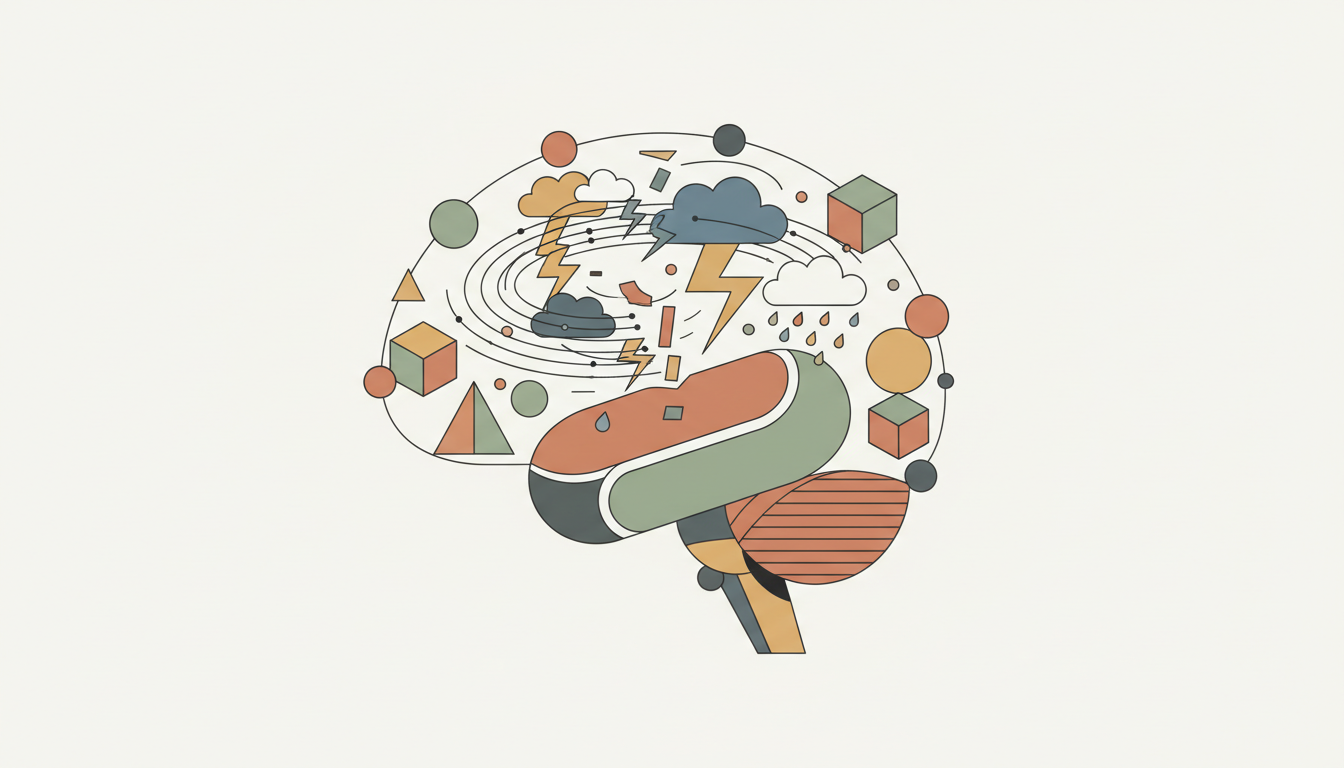
Your Brain Builds Emotion: A Predictive Neuroscience Guide to Feeling Better
Emotions can feel like forces that happen to us, sudden, automatic, and hard to control. But modern affective neuroscience, especially the work of Lisa Feldman Barrett, Ph.D., suggests a more empowering model: your brain is not simply reacting to the world. It is constantly predicting, interpreting, and constructing your experience from the inside out.
This matters for healthspan because emotion is not just a mental event. It is tied to metabolism, stress physiology, inflammation, sleep, relationships, and the behaviors that compound over decades. If emotions are constructed from prediction, then improving those predictions becomes a practical lever for better emotional regulation and long-term resilience.
What You Need to Know First
The conventional view of emotion says that emotions are hardwired biological states. In that model, fear, anger, sadness, and joy are assumed to have distinct signatures in the brain and body. Something happens, your brain detects it, an emotion circuit fires, and your body reacts.
Barrett’s theory of constructed emotion challenges that assumption. In her conversation with Peter Attia, she defines an emotion as “a set of predictions that tells a story about what a set of sensory signals mean to you in that situation.” In other words, your brain receives sensory signals from the outside world and from inside your body, then uses prior experience to make meaning from those signals.
This does not mean emotions are fake. It means they are real constructions, built by a brain trying to regulate the body, make sense of uncertainty, and prepare you for action. The same racing heart could be interpreted as fear before a medical test, excitement before competition, or anger during conflict. The physiological signal matters, but the brain’s interpretation shapes the experience.
A second key concept is allostasis, the brain’s process of anticipating the body’s needs and regulating physiology before problems occur. Unlike homeostasis, which implies returning to a fixed set point, allostasis is predictive. Your brain allocates energy, adjusts heart rate, changes attention, modifies hormone output, and prepares behavior based on what it expects will happen next.
This predictive system is efficient, but it can also create problems. If your brain repeatedly predicts threat, rejection, scarcity, or helplessness, the body may remain in a costly state of vigilance. Over time, that can influence sleep, glucose regulation, immune signaling, cardiovascular strain, and emotional reactivity.
The Science
How It Works
The brain’s job is not primarily to think, feel, or store memories. From an evolutionary perspective, its first job is to manage the body. Every perception, thought, and emotion is linked to the question: what does the body need right now, and what will it need next?
To answer that question, the brain runs predictions. It uses past experience to anticipate what sensory signals mean and what action is most useful. These predictions are compared against incoming data from the world and the body. When the prediction fits, experience feels seamless. When it does not, the brain updates, sometimes consciously, often below awareness.
Emotion emerges from this process. The brain integrates:
- Interoception, signals from inside the body such as heart rate, breathing, temperature, pain, hunger, and fatigue
- Exteroception, signals from the outside world such as faces, voices, light, sound, and movement
- Memory, including learned concepts, past experiences, cultural context, and language
- Action preparation, the body state needed to move, speak, avoid, approach, rest, or repair
This means emotion is not located in one “fear center” or “anger circuit.” The amygdala, insula, anterior cingulate cortex, prefrontal cortex, hypothalamus, brainstem, and autonomic nervous system all participate in different ways, depending on the context. The pattern is distributed and dynamic.
Barrett’s framework also explains why individual variation matters. Averages can obscure how differently people experience, express, and regulate emotion. Two people may both say they feel anxious, but one may be experiencing chest tightness and catastrophic thoughts, while another may be experiencing stomach tension, vigilance, and irritability. Treating those as identical states can miss the biology and context that matter most.
What the Research Shows
The RSS source on Barrett’s interview with Peter Attia highlights a central tension in emotion science: scientists have long searched for objective biological fingerprints of emotions, but clear universal signatures have been elusive. Barrett’s early research reportedly failed to reproduce expected emotion patterns, which led her to question the assumption that emotions are biologically distinct states with fixed bodily markers.
That matters because many popular ideas about emotion still assume a simple one-to-one mapping: anger looks like this, fear activates that, sadness produces this facial expression. Barrett’s work argues for a more flexible model. Emotions are constructed from predictions, bodily signals, learned concepts, and context.
This model aligns with a broader shift in neuroscience toward the brain as a predictive system. Rather than passively waiting for sensory input, the brain is constantly generating expectations. Perception itself is partly constructed. You do not simply see, hear, or feel the world as it is. You experience the world through the lens of what your brain predicts is most likely and most relevant.
The longevity relevance comes through chronic stress and allostatic load. Barrett’s discussion with Attia connects chronic stress, uncertainty, childhood adversity, relationships, and physical health. When prediction systems are repeatedly tuned toward threat or instability, the body may spend more time in metabolically expensive states. This is not just psychological discomfort. It is a repeated allocation of biological resources.
Aging research adds an important layer. A 2023 review in Signal Transduction and Targeted Therapy by Li and colleagues describes aging as characterized by systemic chronic inflammation, cellular senescence, immunosenescence, organ dysfunction, and age-related disease. The authors highlight the senescence-associated secretory phenotype, or SASP, as one contributor to chronic inflammatory signaling.
Another 2023 paper in Nature by Gulen and colleagues identifies the cGAS-STING pathway as a driver of age-related inflammation and neurodegeneration in models of natural aging. This pathway senses abnormal DNA signals and can amplify inflammatory responses. A separate 2023 review by Liu and colleagues in Signal Transduction and Targeted Therapy describes immunosenescence and inflammaging as central features of aging-related disease risk.
These studies do not prove that emotional regulation directly reverses inflammaging. That would be an overstatement. But they do support a broader principle: long-term physiological state matters. Chronic stress, poor sleep, social disconnection, and unresolved threat perception can interact with immune and metabolic systems that are already vulnerable with age.
The evidence is strongest for the idea that emotions are biologically embedded, context dependent, and shaped by prediction. The evidence is more emerging for how specific emotional training practices translate into measurable changes in long-term inflammatory aging pathways. That distinction matters. We can act on plausible, low-risk strategies while remaining honest about what is not yet proven.
Practical Applications
Who Benefits Most
This framework is useful for anyone who feels emotionally “hijacked,” but it may be especially valuable for people living with chronic stress, caregiving demands, grief, high-performance work, sleep disruption, or health uncertainty. These are states where the brain’s predictions can become biased toward danger, urgency, or depletion.
Older adults may also benefit because emotional health is tightly connected to autonomy, social connection, identity, and physical function. The 2026 study by Nivodничева and Беляева examined psychological well-being factors in adults aged 65 to 74, comparing working and nonworking pensioners. While the details provided are limited, the topic itself reflects a key healthspan reality: aging well is not only about disease avoidance. It is also about preserving meaning, agency, connection, and emotional adaptability.
This model is also relevant for clinicians, coaches, and caregivers. If emotions are constructed, then telling someone to “calm down” misses the mechanism. A more useful approach is to change the inputs that shape prediction: bodily state, environment, language, interpretation, relationship, and available actions.
Implementation Considerations
You cannot simply think your way out of every emotional state. Because emotions are built from body signals and predictions, regulation works best when it targets both.
Consider these practical levers:
-
Improve the body budget
- Prioritize regular sleep timing, sufficient protein, hydration, movement, and light exposure.
- A depleted body gives the brain noisier interoceptive signals, which can be interpreted as anxiety, irritability, sadness, or threat.
- Before overanalyzing an emotion, ask: am I hungry, sleep deprived, inflamed, isolated, over-caffeinated, or under-recovered?
-
Use more precise emotional language
- Instead of “I feel bad,” identify whether the state is disappointment, dread, embarrassment, grief, resentment, loneliness, fatigue, or uncertainty.
- This is often called emotional granularity.
- More precise labels can give the brain better concepts, which may improve prediction and action selection.
-
Change the context before changing the thought
- Move your body, step outside, change lighting, slow your breathing, take a walk, or speak with a trusted person.
- Context gives the brain new data.
- Many emotional states soften when the body receives signals of safety, movement, or completion.
-
Practice reappraisal without denial
- Reappraisal means changing the meaning of a situation, not pretending it does not matter.
- Example: “My heart is racing because my body is preparing me to perform,” rather than “Something is wrong with me.”
- The same physiology can support different emotional constructions.
-
Build prediction flexibility through new experiences
- Barrett notes that deliberate practice and new experiences can reshape the brain’s predictions.
- Novel learning, social exposure, skill acquisition, travel, creative work, and challenging but safe experiences can expand the brain’s library of possible interpretations.
- A brain with more concepts has more options.
-
Use relationships as nervous system regulation
- Barrett’s discussion emphasizes that relationships help regulate the nervous system.
- This is not just sentiment. Co-regulation includes voice tone, facial expression, touch, shared routines, and social predictability.
- The loss of a loved one can be physiologically profound because the brain loses a major source of regulation and prediction.
-
Treat chronic uncertainty as a biological stressor
- Uncertainty forces the brain to maintain multiple predictions at once.
- Reduce unnecessary uncertainty where possible: plan meals, clarify finances, create routines, prepare for medical visits, and reduce ambiguous digital inputs.
- Predictability is not boring to the nervous system. It can be metabolically protective.
For people with trauma histories, severe anxiety, depression, panic, or persistent emotional dysregulation, self-guided tools may not be enough. A trained mental health professional can help update threat predictions in a structured and safe way.
Common Mistakes to Avoid
-
Assuming emotions are automatic facts
- Emotions are real, but they are not always accurate readings of the world.
- “I feel unsafe” is a meaningful signal, not proof that danger is present.
-
Trying to suppress the body
- Pushing down emotion often leaves the underlying prediction untouched.
- The nervous system may continue preparing for threat even if you appear calm.
-
Confusing regulation with relaxation
- Sometimes the goal is not to become calm.
- Before a hard conversation or competition, the goal may be readiness, clarity, or courage.
-
Over-pathologizing normal emotion
- Sadness after loss, anxiety during uncertainty, and anger after violation can be appropriate constructions.
- The question is whether the emotion fits the context, helps action, and resolves over time.
-
Ignoring sleep, nutrition, and inflammation
- A brain that is metabolically strained is more likely to construct negative affect from ambiguous body signals.
- Emotional regulation is harder when the body budget is overdrawn.
-
Using “constructed emotion” to blame yourself
- Constructed does not mean chosen.
- Predictions are shaped by biology, history, culture, relationships, and environment. Agency comes from gradually changing inputs, not from self-criticism.
-
Aiming for permanent positivity
- Emotional health is not the absence of unpleasant states.
- It is the capacity to construct useful, context-sensitive responses and recover efficiently.
The Bigger Picture
For healthspan optimization, emotional regulation is often treated as a soft skill. It should be treated as a biological skill. The brain’s predictions influence behavior, sleep, appetite, movement, social connection, pain perception, and stress physiology. Those factors, repeated daily for years, shape long-term risk.
This does not mean mindset can override aging biology. The 2023 research on inflammaging, immunosenescence, SASP signaling, and cGAS-STING makes clear that aging involves complex molecular pathways. Emotional training is not a substitute for exercise, nutrition, medical care, vaccines, cardiometabolic prevention, or sleep.
But it may be one of the systems that helps those other interventions stick. A person who can interpret discomfort accurately, tolerate uncertainty, recover from stress, and maintain supportive relationships is more likely to exercise consistently, make better food choices, adhere to treatment, avoid maladaptive coping, and seek help early.
The most useful takeaway from Barrett’s model is agency without illusion. You cannot choose every emotion in the moment. But you can shape the conditions that your brain uses to build future emotions. You can improve the body budget. You can expand emotional vocabulary. You can create safer relationships. You can practice new interpretations. You can expose the brain to new experiences that update old predictions.
Over time, those inputs can change what the brain expects, and what it expects changes what you feel.
Key Takeaways
-
Emotions are constructed, not simply triggered. Your brain uses prediction, body signals, memory, and context to create emotional experience.
-
Allostasis links emotion to healthspan. The brain constantly regulates the body’s energy needs, and chronic threat prediction can become biologically costly.
-
Better regulation starts with better inputs. Sleep, movement, nutrition, relationships, environment, and language all shape emotional predictions.
-
Emotional granularity is a practical skill. Naming feelings precisely gives the brain better concepts and can support more adaptive action.
-
Agency is built over time. You may not control an emotion instantly, but repeated practice, new experiences, and supportive relationships can reshape future emotional patterns.