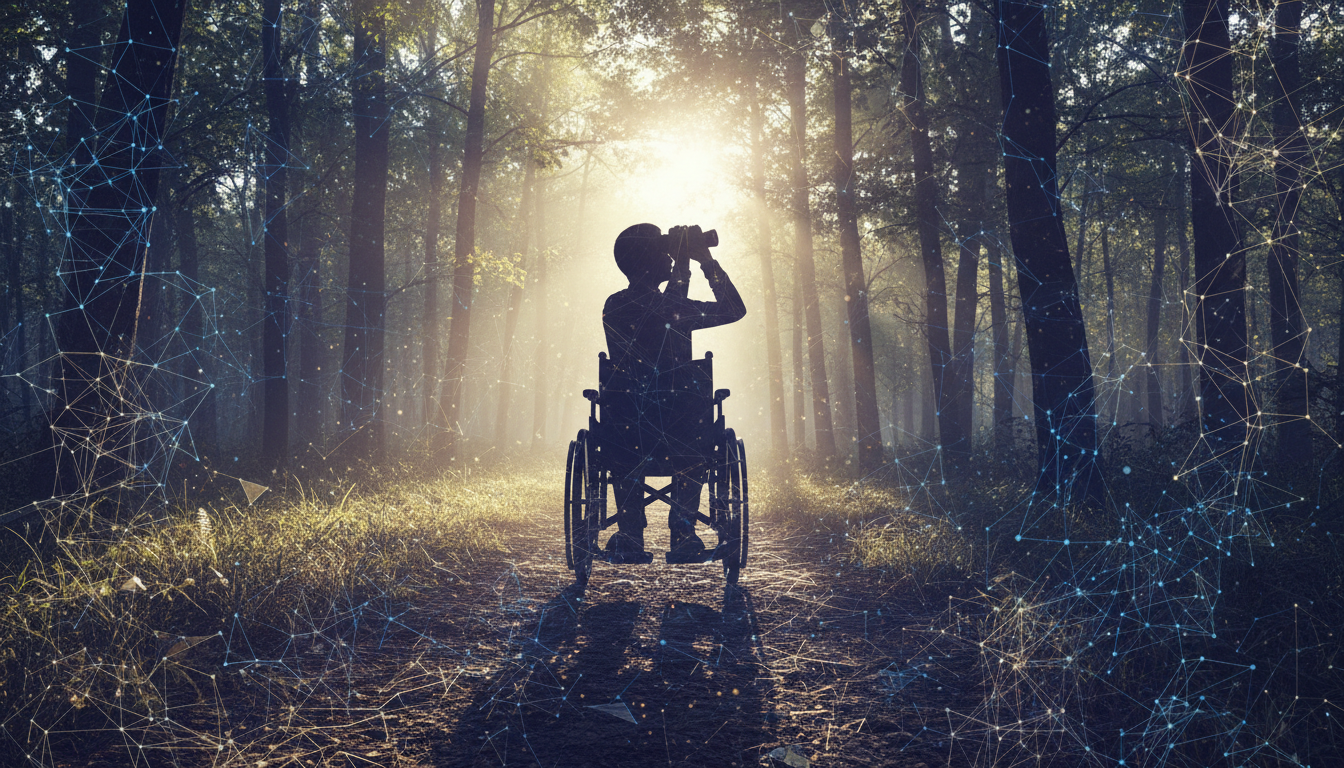
Wheelchair Birding Is Not “Less Exercise”, It Is a Durable Healthspan Habit
The Reality
Adaptive outdoor hobbies like wheelchair birding can meaningfully support healthspan because they combine three protective inputs most people struggle to sustain over decades: regular movement, cognitive challenge, and social connection. The point is not to replicate the energy cost of a steep hike. The point is to build an activity you can keep doing through arthritis, neuropathy, cardiopulmonary disease, injury, or post surgical limitations, without dropping out of life outdoors.
That matters because population aging is accelerating, and public health strategies increasingly emphasize function, participation, and environments that enable older adults to stay engaged, not just disease treatment. Narrative reviews in public health underscore that healthy aging is shaped by systems and access, including supportive community design and opportunities for ongoing engagement (Khan, Addo, Findlay, 2024; Gianfredi, Nucci, Pennisi, et al., 2025). Wheelchair birding fits that model: it is an accessible, repeatable pathway to keep moving, keep learning, and keep showing up.
The Misconception
A common belief is that if you are birding from a wheelchair, you are not getting “real” physical activity, and the health benefits are minimal compared with walking trails. This is understandable because many fitness messages equate benefit with intensity, and outdoor recreation is often framed as summit driven or step count driven.
But healthspan is not a single workout. It is the accumulation of weekly behaviors you can sustain.
Why It’s Wrong
First, movement is not binary. For many wheelchair users, the relevant comparison is not “wheelchair birding vs mountain hiking.” It is “wheelchair birding vs staying indoors.” The health impact of getting outside, transferring in and out of a vehicle, propelling a chair (manual or power with active trunk control), navigating surfaces, and performing repeated upper body tasks (binocular handling, camera positioning, scanning) can add up to meaningful physical work. More importantly, it preserves a pattern of frequent activity, which is a cornerstone of maintaining function.
Second, the myth ignores how much of healthy aging depends on participation and mental health, not just cardiorespiratory load. A 2024 paper in The Lancet Healthy Longevity across 24 countries found that social activities and loneliness are strongly linked with depressive symptoms in adults 50 and older, and that social engagement can mediate risk (Wang, Liu, Yang, et al., 2024). Wheelchair birding is inherently participation oriented. It creates routine, shared goals, and low pressure conversation, all of which reduce isolation risk.
Third, adaptive outdoor hobbies engage the brain in a way that looks a lot like cognitive training, but with better adherence. Birding requires selective attention (filtering calls and movement), working memory (holding field marks), pattern recognition (silhouette, flight style), and reward learning (the brain gets reinforced by spotting and identifying). This is not a substitute for medical care, but it is a credible mechanism for supporting cognition over time through repeated, enjoyable practice.
Finally, the misconception misses the public health reality: as societies age, the winning strategy is not telling people to do activities they cannot access. It is designing environments and communities that keep people engaged across changing ability. Both Khan et al. (2024) and Gianfredi et al. (2025) highlight aging as a systems challenge, where supportive policies and accessible opportunities help maintain quality of life and reduce downstream burden.
What the Evidence Shows
The strongest evidence base here is not a single “wheelchair birding trial.” It is the convergence of three well supported healthspan principles:
1) Consistency beats intensity for long term function
Healthy aging frameworks increasingly prioritize maintaining mobility and independence through sustainable behaviors (Khan et al., 2024; Gianfredi et al., 2025). Wheelchair birding is repeatable, low barrier, and scalable. That is exactly what makes it potent over years.
2) Social participation is a mental health intervention hiding in plain sight
The Lancet Healthy Longevity analysis (Wang et al., 2024) reinforces that social activity and loneliness are not side issues, they are central drivers of depressive symptoms in older adults. Birding groups, accessible hides, and inclusive outings convert “exercise” into belonging, which is often the missing ingredient for adherence.
3) Outdoor attention training supports cognition and mood through multiple pathways
Mechanistically, time outdoors paired with purposeful attention can support mood via stress reduction and positive affect, and support cognition via novelty, learning, and goal directed focus. Even when physical intensity is modest, the combination of movement plus cognitive load plus social reinforcement creates a high leverage healthspan stack.
Put differently, wheelchair birding is not a consolation prize. It is an example of how accessibility design becomes preventive medicine.
What This Means for You
If you want an outdoor hobby that supports healthspan, optimize for durability, not prestige. Use wheelchair birding as a template for any adaptive activity that you can do weekly for years.
A simple “Access Plus” protocol for wheelchair birding
- Choose routes that reduce friction, paved loops, boardwalks, or accessible blinds. Less friction means more reps.
- Build a minimum dose routine, 20 to 40 minutes, 2 to 4 times per week, even if the outing feels easy.
- Add a cognitive target, identify 3 species, learn 1 new call, or track 1 behavior (feeding, nesting, flight pattern).
- Make it social by default, join an accessible bird walk, invite a friend, or share sightings in a local group.
- Progress the challenge safely, slightly longer routes, more varied habitats, or a “one new bird per week” goal.
The core fact to keep: wheelchair birding is a legitimate healthspan practice because it preserves participation, supports mood, trains attention, and keeps movement in your life when many people otherwise stop.