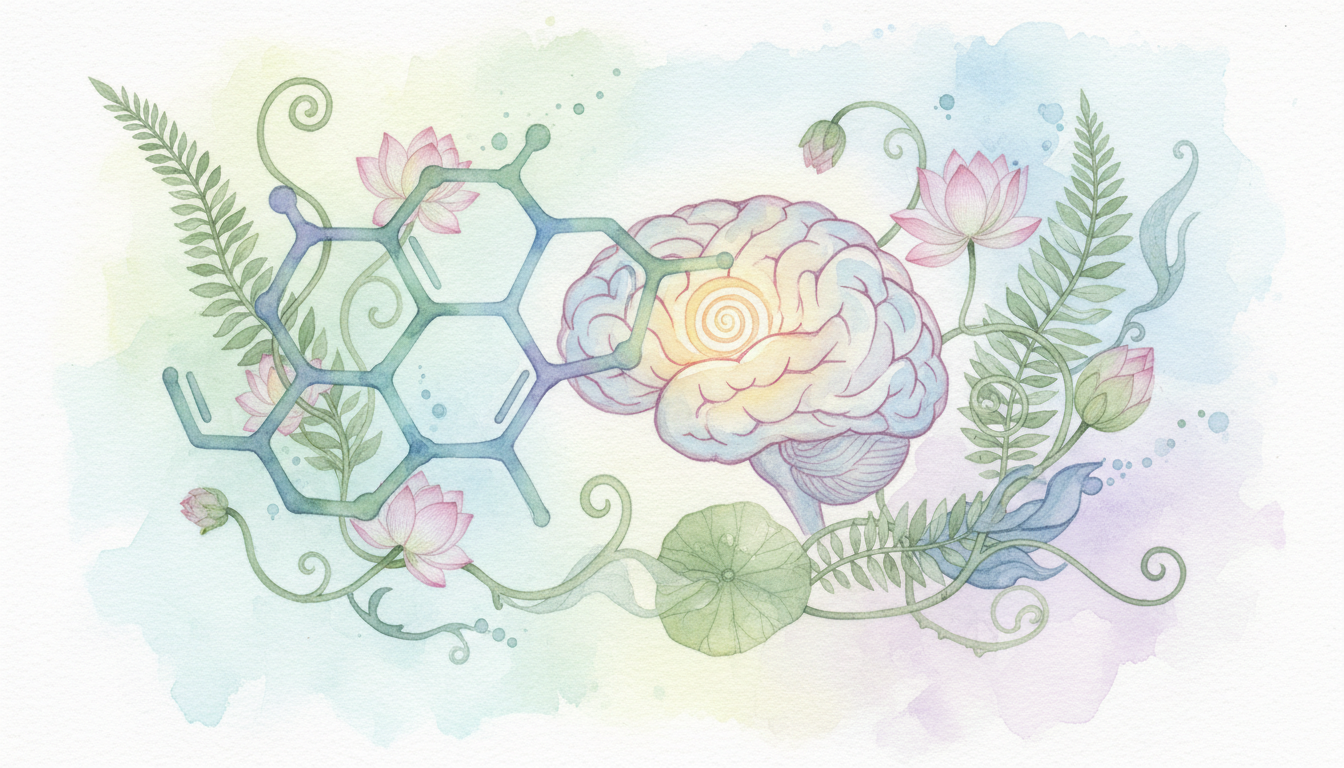
L-Theanine for Men: Calm Focus as a Molecular Recovery Signal
The Problem
You want sharper focus, but the usual tools come with a cost. More coffee gets you moving, but it can also make your thoughts feel scattered, your jaw tight, and your sleep lighter than it should be. You may be productive on paper, yet your nervous system feels like it is running one gear too high.
For many men, the pattern is familiar: high work demand, intense training, caffeine before noon, screens at night, and a brain that refuses to downshift. You can still perform, but recovery starts to lag. Sleep becomes less restorative. Patience gets thinner. Training feels harder than it should. The problem is not simply “stress.” It is the inability to switch cleanly between drive mode and repair mode.
That is where L-theanine becomes interesting. Not as a miracle supplement, and not as a shortcut around sleep, exercise, or nutrition. Its real value is more specific: it may help tune the excitatory and inhibitory signaling systems that govern calm attention, which is exactly where many high-performing men get stuck.
Why It’s Harder Than You Think
Stress is not just a feeling. It is a coordinated biological state involving the brain, adrenal system, cardiovascular system, immune system, and metabolism. When you are under pressure, your body increases sympathetic output, mobilizes glucose, raises vigilance, and biases the brain toward threat detection and rapid response. That is useful in short bursts. It is costly when it becomes your default setting.
Conventional advice often misses this. “Just relax” does not work when your neurochemistry is biased toward arousal. “Just push harder” works until it does not. Caffeine can improve alertness, but in some men it also amplifies the same catecholamine-driven state they are trying to control. The result is a strange combination: wired but unfocused, tired but unable to sleep deeply.
The longevity angle matters here. A 2023 review in Antioxidants by Maldonado and colleagues described oxidative stress as a central contributor across multiple hallmarks of aging, including mitochondrial dysfunction, genomic instability, impaired proteostasis, and chronic inflammation. That does not mean stress “ages you overnight.” It means repeated activation without adequate recovery can push biology toward a less resilient state.
Newer aging science is also moving from vague wellness language toward measurable biology. A 2024 Nature Medicine study by Argentieri, Xiao, Bennett, and colleagues developed a proteomic aging clock using 2,897 plasma proteins and found that protein-based biological age predicted disease risk and mortality. A 2023 Nature Aging study by Lu, Fei, Haghani, and colleagues showed that DNA methylation clocks can estimate biological age across mammalian tissues. These tools do not prove L-theanine extends lifespan, but they reinforce an important point: aging is partly reflected in molecular patterns affected by inflammation, stress signaling, sleep, metabolism, and repair.
So the question is not “Can L-theanine make men live longer?” That claim would be too strong. The better question is: Can L-theanine support the nervous-system conditions that make better recovery, better focus, and healthier aging biology more likely?
What the Science Suggests
L-theanine is a non-protein amino acid found naturally in tea, especially green tea. Its appeal is not that it sedates you. It is that it appears to promote calm alertness, a state where the brain is awake but less reactive.
Mechanistically, L-theanine is structurally similar to glutamate, the brain’s primary excitatory neurotransmitter. Because of this, it may influence glutamatergic signaling without simply “turning the brain off.” It also appears to interact with inhibitory systems, including GABA-related pathways, and may affect neurotransmitters involved in mood and attention such as dopamine and serotonin. The practical translation is simple: L-theanine may help shift the brain away from excessive excitation and toward a more balanced signal-to-noise ratio.
This is why many men notice the biggest benefit when L-theanine is paired with caffeine. Caffeine blocks adenosine receptors, increasing alertness and reducing perceived fatigue. But for some people, that alertness comes with jitteriness, impatience, or fragmented attention. L-theanine may smooth that edge by supporting alpha-wave activity, a brain rhythm associated with relaxed wakefulness. You are not trying to blunt performance. You are trying to make performance cleaner.
There is also a recovery angle. If your evenings are dominated by residual stimulation, work stress, or rumination, your sleep architecture can suffer. L-theanine is not a sleeping pill, and it should not be treated like one. But by supporting a calmer pre-sleep nervous-system state, it may help some men transition more effectively into recovery. Since sleep is one of the most powerful regulators of testosterone rhythms, glucose control, immune function, and brain clearance systems, anything that improves sleep readiness without impairing sleep quality deserves attention.
From a longevity perspective, the key mechanism is indirect but important. L-theanine is not known as a primary “anti-aging compound.” Its more realistic role is as a state regulator: helping reduce excessive arousal, supporting focused cognition, and potentially improving the conditions under which repair biology can occur. That matters because the molecular hallmarks of aging are not isolated from daily inputs. Stress load, sleep quality, metabolic stability, and oxidative balance all feed into the biology that aging clocks are beginning to quantify.
The nuance: responses vary. Some men feel a clear difference. Others feel little. Genetics, caffeine sensitivity, sleep debt, baseline anxiety, alcohol intake, and training load can all change the effect. L-theanine works best when it is matched to the right problem: overactivation, not under-motivation.
A Path Forward
Think of L-theanine as a tool for nervous-system precision, not a daily requirement. The goal is to identify where your stress and focus system breaks down, then apply it strategically.
A practical protocol framework
-
For caffeine-driven focus:
If coffee makes you productive but edgy, consider pairing caffeine with L-theanine rather than adding more caffeine. Many human studies use L-theanine in the low hundreds of milligrams range, often alongside caffeine, but your personal starting point should be conservative and aligned with product labeling or clinician guidance. -
For deep work blocks:
Use it before cognitively demanding work when you want calm concentration, not stimulation for its own sake. Track whether it improves output quality, task persistence, and mental steadiness. -
For evening downshifting:
If your main issue is rumination at night, test whether L-theanine earlier in the evening helps you transition away from work mode. Avoid using it to compensate for late caffeine, alcohol, or inconsistent sleep timing. -
For high-stress training periods:
During phases of heavy lifting, endurance work, or caloric restriction, watch for signs of nervous-system overload: poor sleep, elevated resting heart rate, lower HRV, irritability, and stalled performance. L-theanine may be useful as part of a broader recovery stack that includes carbohydrates when appropriate, magnesium-rich foods, light exposure, and sleep consistency. -
For men monitoring longevity markers:
Pair subjective effects with objective data. Track sleep duration, sleep efficiency, resting heart rate, HRV, blood pressure, fasting glucose if relevant, and mood. The benefit is not whether you “feel relaxed” once. The benefit is whether your recovery trend improves.
Use it intelligently
Do not combine L-theanine casually with sedatives, alcohol-heavy evenings, or complex medication regimens without professional input. If you have low blood pressure, psychiatric conditions, sleep disorders, or take medications affecting mood, attention, or blood pressure, talk with a clinician first.
Also, do not let supplements replace the big levers. If your sleep is five hours, your caffeine is late, your alcohol intake is high, and your training has no recovery structure, L-theanine will not fix the system. It may help you feel the difference between forced productivity and regulated performance, but the foundation still matters.
The Bottom Line
For men, the best case for L-theanine is not hype about instant calm or guaranteed longevity. It is a mechanistic case: L-theanine may help balance excitatory signaling, support relaxed focus, and improve the transition from stress output to recovery input. In a world where aging biology is increasingly measured through proteins, methylation patterns, inflammation, and oxidative stress, the daily ability to regulate your nervous system is not soft wellness. It is part of the molecular environment your body ages in.