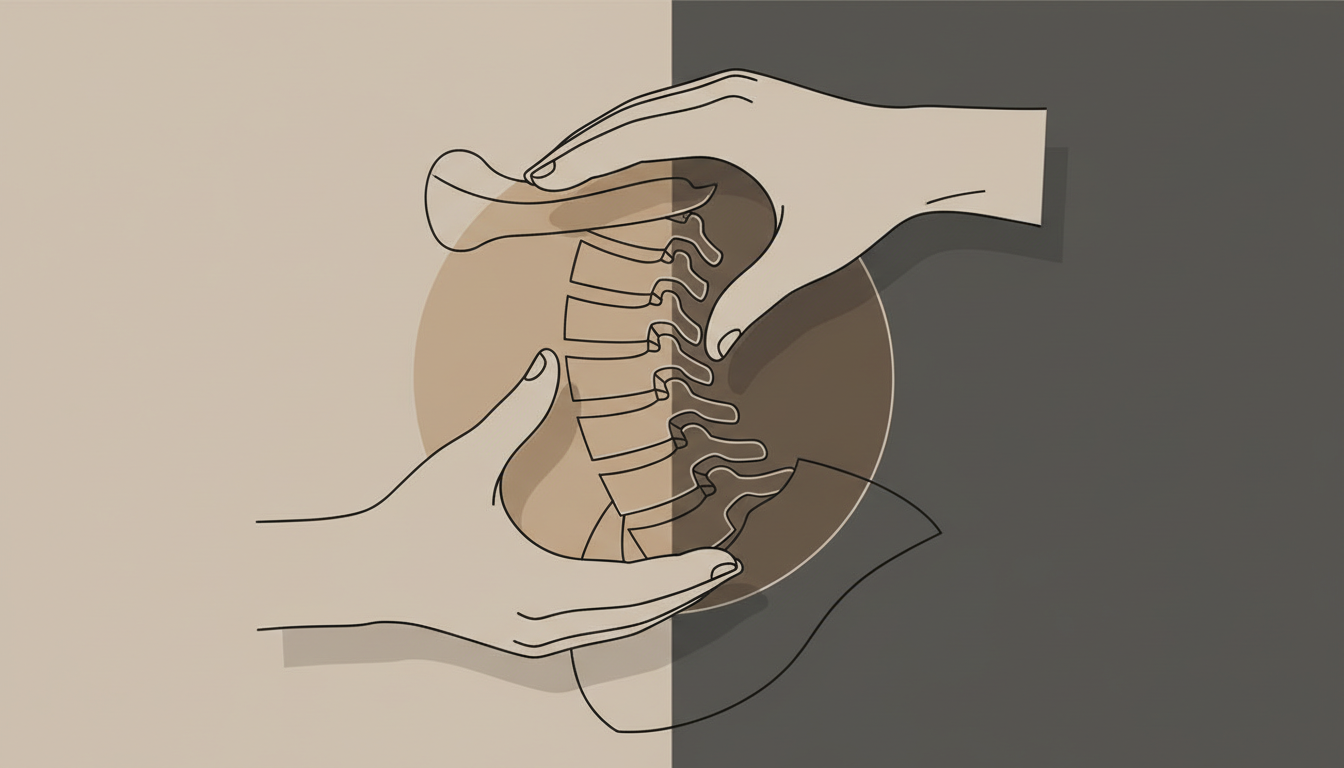
Chiropractic Safety Depends on the Technique, Not Just the Practitioner
In a 2008 Ontario study covering more than 100 million person-years, researcher J. David Cassidy and colleagues found no evidence of excess vertebrobasilar stroke risk after chiropractic visits compared with primary care visits. The finding does not establish that neck manipulation is risk-free: early artery injury can itself cause headache or neck pain, prompting people to seek care before a stroke occurs. For anyone considering chiropractic treatment, the body region, technique and individual medical history matter.
What Researchers Found
The Cassidy study identified 818 hospitalized vertebrobasilar strokes, which affect circulation to the back of the brain. Researchers compared prior chiropractic and primary care visits to investigate an association that is difficult to interpret: people with an artery dissection, a tear in an artery wall, may seek help for a headache or neck pain before the dissection leads to stroke.
The study did not show that neck manipulation caused strokes, nor did it rule out the possibility that manipulation could contribute to some cases. It also could not establish exactly which procedures patients received at each visit. That limits what it can tell us about the safety of any particular adjustment.
Chiropractic care includes more than the rapid spinal thrusts many people picture. It can also involve slower joint mobilization, soft-tissue work, exercise advice or handheld instruments. As the Restore Health & Longevity Center article describes, techniques vary in their target, force and approach. The key question is not simply whether “chiropractic” is safe, but what is being done, where and why.
Why This Matters for Healthspan
Persistent back or neck pain can make it harder to exercise, sleep and carry out daily activities. Spinal manipulation may provide modest relief for some adults with nonspecific low back pain, but it is not the only option. Exercise-based rehabilitation, physical therapy and other approaches may also be worth discussing.
For older adults, the goal is not just temporary pain relief. It is preserving strength, mobility and independence without overlooking conditions that make a treatment inappropriate. A 2024 JAMA review by Cathleen Colon-Emeric and colleagues identified gait and balance problems, medication effects, sensory impairment and environmental hazards among modifiable fall risks. It did not establish chiropractic care as a fall-prevention strategy.
The Mechanism
A high-velocity spinal manipulation applies a quick, controlled thrust to a joint. The familiar popping sound can occur as pressure changes within the joint; it does not prove that a bone was “put back in place.” Slower mobilization moves a joint without the same rapid thrust, while instrument-assisted approaches deliver a mechanical impulse through a device.
These techniques place different mechanical forces on tissues, but a gentler-sounding label does not by itself prove that a technique is safe or effective for a particular person. Short-lived soreness or stiffness can follow manual treatment. Rare serious complications have also been reported, including fractures or worsening neurological injury in susceptible patients.
The neck deserves particular attention because it contains arteries supplying the brain as well as the spinal cord and nerves. Upper-cervical treatment targets the region near the skull, but that does not remove vascular or neurological concerns. The available evidence does not reliably quantify the risk of serious complications for every technique or identify a universally risk-free neck adjustment.
Context and Limitations
Safety depends partly on whether an underlying condition is recognized before treatment. Osteoporosis, suspected fracture, spinal instability, progressive neurological symptoms or a history of vascular problems can change the risk assessment. A disc problem also requires individual evaluation: an adjustment does not repair a herniated disc simply because it targets another part of the spine.
Imaging can be useful when a clinician suspects a specific problem, but routine X-rays are not necessary for every patient and cannot, on their own, prove that manipulation is safe. Evidence is also limited for spinal manipulation in children, particularly for conditions unrelated to muscles and joints. Parents considering care for an infant or child should discuss the proposed treatment with their pediatrician.
Practical Implications
Before agreeing to treatment, consider asking:
- What is the goal? Ask which symptom or functional problem is being treated, how benefit will be measured and what alternatives are available.
- What will you do? Clarify the body region, whether a rapid thrust is planned and whether a non-thrust approach is an option.
- What changes my risk? Share relevant history, including osteoporosis, recent injury, neurological symptoms, vascular problems and medications such as blood thinners.
- When will we reassess? Improvement should be reviewed rather than assuming that ongoing adjustments or monthly checkups are necessary. Routine chiropractic visits have not been proven to prevent disease.
Mild soreness or stiffness after treatment may be temporary. Seek emergency medical evaluation for sudden severe or unusual headache or neck pain, weakness or numbness, trouble speaking, double vision, difficulty walking or sudden severe dizziness, whether symptoms occur before or after treatment. New loss of bladder or bowel control, or numbness around the groin or saddle area, also warrants emergency assessment. Worsening pain, fever or progressively worsening neurological symptoms should prompt urgent medical evaluation.
The safest choice is an informed one: understand the proposed technique, weigh its likely benefit against your individual risks and choose care that supports the activities you want to maintain.