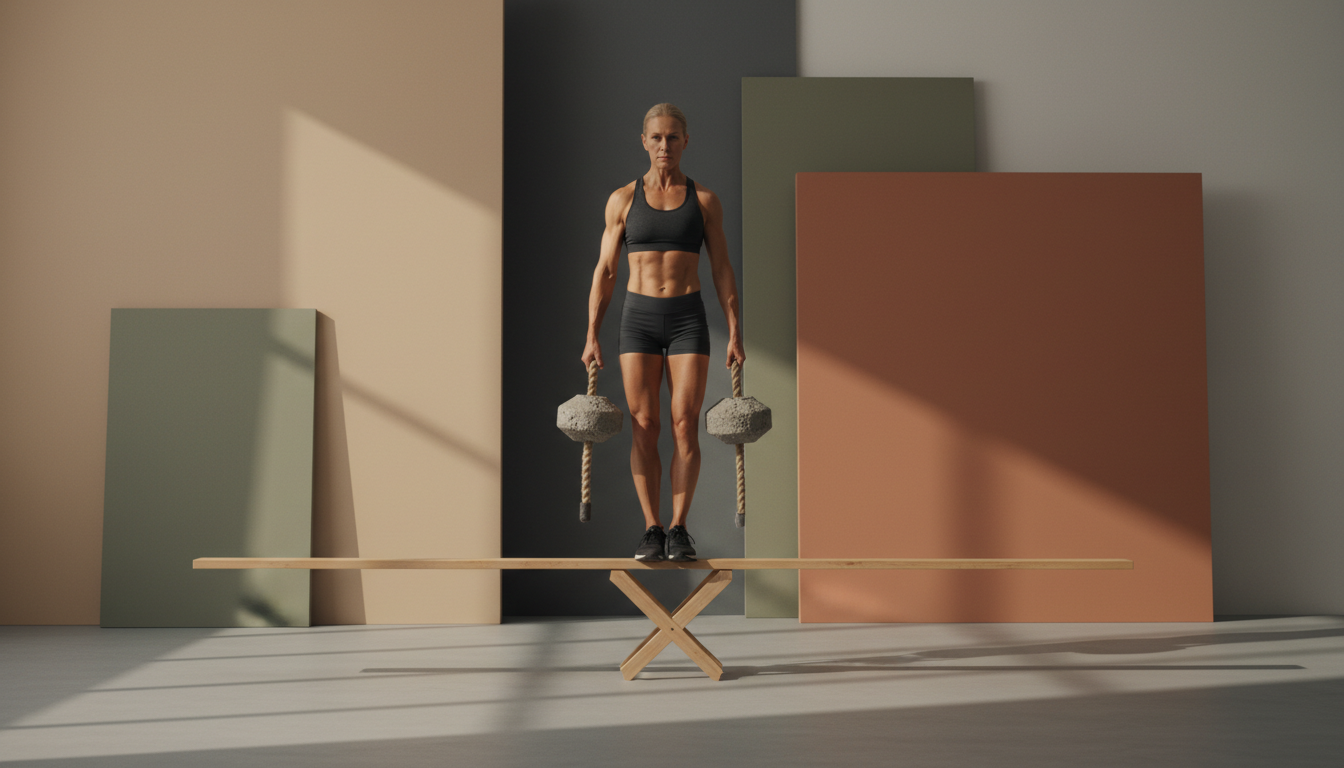
After 45, Fitness Should Train Capacity, Not Just Burn Calories
Three 2023 reviews point to the same practical message for adults over 45: the fitness that protects healthspan is the kind that preserves muscle, movement, balance, and metabolic reserve. Research in Nutrients and Diabetes, Metabolic Syndrome and Obesity linked sarcopenia with cognitive decline and type 2 diabetes, while a Cochrane review led by Moritz Ernst found that multiple forms of exercise improved motor signs and quality of life in Parkinson’s disease. The impact is clear: after midlife, exercise should be treated less like a weight-loss tool and more like a protocol for maintaining the systems most vulnerable to aging.
What Researchers Found
The strongest signal across recent research is that muscle is not just tissue for movement. In a 2023 review in Diabetes, Metabolic Syndrome and Obesity, Chen and colleagues described sarcopenia as an increasingly recognized complication of type 2 diabetes. The relationship appears bidirectional: insulin resistance, inflammation, oxidative stress, and advanced glycation end products can accelerate muscle loss, while lower muscle mass and strength worsen glucose disposal.
A separate 2023 review in Nutrients by Arosio and colleagues connected sarcopenia with cognitive decline through the muscle-brain axis. The authors highlighted overlapping mechanisms between muscle aging and brain aging, including mitochondrial dysfunction, chronic inflammation, impaired cellular signaling, and metabolic disruption. In practical terms, declining strength and declining cognition may not be isolated events. They may reflect shared biological stress across multiple systems.
The Cochrane review by Ernst, Folkerts, Gollan, and colleagues looked at physical exercise in adults with Parkinson’s disease and found that different exercise types can improve motor signs and quality of life. While Parkinson’s is a clinical population, the broader relevance is important: movement diversity matters. Strength, balance, gait, dance, endurance, and functional training each target different parts of the neuromuscular system.
A 2023 review in the Journal of NeuroEngineering and Rehabilitation by Lam, Tang, and Fong adds another layer: markerless motion capture is being explored as a clinical tool to measure movement quality without attaching sensors to the body. The technology is still early, but it reflects a shift in health assessment. Fitness is moving beyond “how much do you weigh?” toward “how well do you move?”
Why This Matters for Healthspan
After 45, the goal of training changes. The main enemy is no longer simply excess body fat or low motivation. It is the gradual loss of physiological reserve, the extra capacity that lets you recover from illness, climb stairs without fatigue, catch yourself during a stumble, carry groceries, regulate glucose, and maintain independence decades later.
This is why the most important fitness question after midlife is not “What burns the most calories?” It is:
What capacities am I protecting?
For healthspan, the core capacities are:
- Strength, especially legs, hips, back, and grip
- Muscle mass, because skeletal muscle is a glucose sink and amino acid reserve
- Power, the ability to produce force quickly
- Aerobic capacity, the engine for cardiovascular and mitochondrial health
- Balance and coordination, which reduce fall risk and preserve confidence
- Mobility, the usable range of motion required for real life
A person can look fit and still be fragile if they lack these capacities. Conversely, a simple, repeatable training plan can be highly protective even if it does not resemble elite athletic training.
The Mechanism
Muscle is one of the body’s largest metabolic organs. When you contract skeletal muscle, you improve glucose uptake, stimulate mitochondrial adaptation, increase local blood flow, and release signaling molecules called myokines. These signals influence inflammation, insulin sensitivity, vascular function, and potentially brain health.
This is why resistance training is central after 45. It provides mechanical tension, the key signal that tells the body to keep muscle tissue. Without that signal, aging, inactivity, inflammation, and insulin resistance push the body toward sarcopenia. The result is not just weakness. It is a smaller metabolic reservoir.
Aerobic training works through a different but complementary pathway. It improves mitochondrial efficiency, cardiac output, endothelial function, and the ability to use oxygen. Low to moderate intensity aerobic work builds the base. Higher intensity work, used carefully, helps preserve peak capacity, which tends to decline with age.
Balance, coordination, and movement-skill training protect the nervous system side of fitness. The Cochrane Parkinson’s review is useful here because it shows that exercise is not only about muscles and lungs. It also challenges motor control, rhythm, gait, posture, and confidence. These are healthspan variables, even when they are not captured on a bathroom scale.
Context and Limitations
The recent research does not prove that one universal workout plan prevents diabetes, dementia, Parkinson’s disease, or frailty. Much of the sarcopenia literature is mechanistic or observational, and clinical populations do not perfectly map onto healthy adults over 45. Exercise studies also vary in intensity, duration, supervision, and adherence.
But the direction of evidence is consistent. Muscle quality, physical performance, and movement capacity are deeply connected to aging biology. The practical takeaway is not that everyone needs extreme training. It is that adults over 45 should stop relying on random workouts and start training the capacities most likely to determine future independence.
Practical Implications
A useful after-45 fitness protocol is simple, measurable, and repeatable. It should cover strength, aerobic base, power, balance, and mobility every week.
The 5-Part Weekly Protocol
1. Strength train 2 to 3 days per week
Prioritize large movement patterns:
- Squat or step-up
- Hip hinge, such as deadlift variation or hip thrust
- Push, such as push-up or press
- Pull, such as row or pulldown
- Carry, such as farmer carry or suitcase carry
A practical structure is 2 to 4 sets per movement, using a load that feels challenging but controlled. The goal is not exhaustion. The goal is progressive competence.
2. Add power before strength work
Power declines faster than strength and is critical for fall prevention. Keep this safe and low volume.
Examples:
- Fast sit-to-stand
- Medicine ball throw
- Light kettlebell swing
- Step-up with intent
- Short hill walk or stair burst
Think crisp, controlled, and non-fatiguing. Power training should feel sharp, not sloppy.
3. Build an aerobic base 2 to 4 days per week
Use brisk walking, cycling, rowing, swimming, hiking, or incline treadmill work. Most sessions should be conversational but purposeful.
A practical target is 30 to 45 minutes per session. This supports mitochondrial function, cardiovascular health, and recovery capacity.
4. Include one higher-effort session if appropriate
For people who are already active and medically cleared, one weekly interval session can help preserve peak capacity.
Examples:
- 4 rounds of 3 minutes hard, 3 minutes easy
- 6 to 8 short hill efforts
- 10 rounds of 30 seconds brisk, 90 seconds easy
This is optional, not mandatory. If recovery suffers, reduce intensity first.
5. Train balance and mobility daily in small doses
This does not need to be a separate workout. Use 5 to 10 minutes.
Examples:
- Single-leg balance near support
- Controlled lunges
- Hip mobility drills
- Thoracic rotations
- Calf and ankle work
- Slow floor-to-stand practice
The key is consistency. Balance and mobility respond well to frequent exposure.
The Better Metrics After 45
Instead of tracking only weight or calories, monitor functional markers:
- Can you get up from the floor without using your hands?
- Is your grip strength improving?
- Can you carry heavy bags without pain or breathlessness?
- Can you climb stairs while breathing comfortably?
- Is your walking speed stable or improving?
- Are you maintaining muscle while keeping glucose and waist size in check?
The fitness that matters after 45 is not the most punishing workout. It is the plan that keeps you strong, metabolically resilient, neurologically coordinated, and capable in the real world.